Landlessness and rural poverty in Ljuder
The EmigrantsLandlessness and rural poverty in Ljuder describe a widening gap between the parish’s inherited agrarian way of life and the resources available to its growing population. Farms were divided across generations while the number of people without secure property or permanent homes increased; poverty took the form not only of hunger, but also of dependency, restricted choices, and uncertain prospects for children. These pressures frame the emigrants’ departure as a response to conditions at home, even as the decision to leave required money, information, and a collective journey.
Land, Population, and Fragmented Farms
The parish economy rested on land worked by families over generations. The farm supplied food, clothing materials, and household necessities, while work followed the seasonal cycle. But the security of this self-contained world depended on access to enough land. In Ljuder, that access contracted as properties were divided among heirs: 43 original homesteads, held by 87 owners in 1750, had become 254 independent farms by 1846. Two-thirds of those farms were one-eighth of an original homestead or smaller. Only four holdings still exceeded a full homestead: the freeholds of Kråkesjö and Gösamåla, the parsonage, and the sheriff’s manse at Ålebäck.
Demographic growth intensified this fragmentation. On January 1, 1846, Ljuder Parish had 1,925 inhabitants, 998 male and 927 female. Over the century after 1750, its population had nearly tripled, while the number of nonassessed people—including retired older people, cottagers, squatters, servants, parish dependents, and people without permanent homes—had increased fivefold. The figures convey a structural problem rather than a single bad season: more people depended on a finite agrarian base, and the division of property left most farms too small to support a broad household securely.
Agriculture and cattle raising were the main livelihoods, supplemented by handicraft. Brännvin distilling also formed part of farm income: in the 1840s, the parish had around 350 stills, and about one person in six owned a vessel. The need to sell some of the product to make farming profitable points to the narrowness of household finances. Landlessness and poverty therefore belonged to an interconnected economy of small holdings, limited employment, and dependence on whatever income a household could secure.
Poverty and Parish Relief
Those without adequate land or independent means appeared in the parish’s records in many different circumstances. Alongside 254 peasants and cottagers living on assessed land were 92 squatters and 274 farm servants, as well as artisans, soldiers, innkeepers, horse traders, and peddlers. The parish register also distinguished older people, sick and disabled residents, people described as unable to work, poor dependents, and others living at the margins of established households. Its final page listed 27 people who had moved away and were never heard from again, a stark indication of how easily a person might pass beyond the community’s knowledge.
Parish assistance did not erase these differences; it classified them. The parish council divided poor and dependent residents into three groups. People considered entirely incapacitated could receive “complete sustenance,” potentially as much as three riksdaler in cash a year and four bushels of barley. Those judged partly disabled, but able to earn something for themselves and their children, received twelve shillings to one riksdaler and at most two bushels of barley. Temporary assistance came from the Ljuder Parish Poor Purse, also supervised by the council.
The third category included people the council regarded as responsible for their own poverty. Its regulations called for them to receive the smallest aid, in the hope that this would accustom them to sobriety and industry. Relief was consequently both support and discipline: help was limited according to judgments about a recipient’s capacity and conduct. The sums recorded underline how little security the system could offer. Even the highest stated annual cash allowance was modest, and the barley allotments remained finite.
Destitute children faced a related form of dependence. The parish council auctioned orphans to homes it considered suitable, seeking families that would provide care and teach habits of work. The language of provision thus joined protection to labor and discipline. For families contemplating the future, poverty was not only an immediate shortage; it was the possibility that children might grow up without land, household security, or control over where they worked.
Inheritance and the Next Generation
The force of these conditions appears in the choices facing Karl Oskar Nilsson and Kristina Johansdotter. Their concern was not simply whether they could continue working in Korpamoen, but what their children could inherit from a farm already burdened by obligations. As Karl Oskar considered the future, he saw one child receiving the farm while the others would have to become hired farmhands or squatters. He and Kristina did not want their children confined to those alternatives, and they believed that remaining in their impoverished surroundings offered no better solution.
Inheritance could preserve a family’s connection to its land while dividing its resources. When Karl Oskar took over Korpamoen, each child received a share of the inheritance; Robert and Lydia, still under age, left their portions as claims against their brother. The arrangement made kinship an economic obligation as well as a bond. For the younger generation, the small farm could not simply be divided again without worsening the problem it was meant to solve.
The older generation’s reserved rights further tied the farm’s survival to family care. Nils and Märta retained the right to live in the spare room, keep one cow and one sheep, cultivate three-quarters of an acre, use the owner’s team, and receive twelve bushels of grain each year. Such provisions protected the parents, but they also placed a continuing burden on a small holding. Poverty in this setting was therefore shaped by reciprocal obligations: maintaining the older generation was necessary, yet the land and income available to meet those obligations were limited.
Nils’s quiet warning to his son gave the conflict a longer horizon. When Karl Oskar described the six people who would go, Nils replied that his son was taking many more than he knew: his descendants. The remark connects one household’s migration decision to the generations who might otherwise inherit the same constraint. Leaving was not merely a response to present hardship; it was an attempt to alter what could be passed on.
Emigration as an Answer to Poverty
The novel places Ljuder’s land pressure within a larger migration movement. News of fertile land in North America traveled from neighbor to neighbor into communities long governed by inherited routines. The destination was only partly known: pictures and rumors offered a promise, while the ocean and the land beyond it remained uncertain. The impulse to leave did not have a single cause. The landless, the debt-bound, the suppressed, and the discontented could be drawn by different hopes or pushed by different difficulties; some emigrated less toward a particular reward than away from the dilemmas of home.
For Karl Oskar and Kristina, the imagined attraction was the chance to improve their lot through their own work. They believed that fertile, stone-free land might be obtained for little, and that they could bring the abilities their present lives had taught them. Their hope did not depend on a promise of easy labor. Rather, the decisive contrast was that work in America might lead somewhere, while effort at Korpamoen seemed unable to change their circumstances or secure a future for all their children.
The decision required practical arrangements as well as conviction. Karl Oskar and Robert wrote to a firm in Karlshamn and secured passage for six on the merchant vessel Charlotta, paying a deposit of one hundred daler. The planned spring departure was tied to the farming year: emigrants hoped to arrive early enough to till and sow and obtain an autumn harvest. Robert also undertook to seek a passage contract for Danjel Andreasson if the ship had room, turning individual plans into a larger movement linked by household ties and shared transport.
At Åkerby Junction, sixteen emigrants—nine adults and seven children—met to continue the journey together. The group included the families and companions traveling from Korpamoen and Kärragärde, as well as Robert and Arvid, whose departure had not unfolded as they had once planned. The assembled party made visible how private decisions about land, work, and family could become a collective migration. The journey promised escape from the parish’s narrow economic prospects, but its first threshold was a road that required those leaving to separate from the people and places that had formed their lives.
Objects, Departure, and the Meaning of Constraint
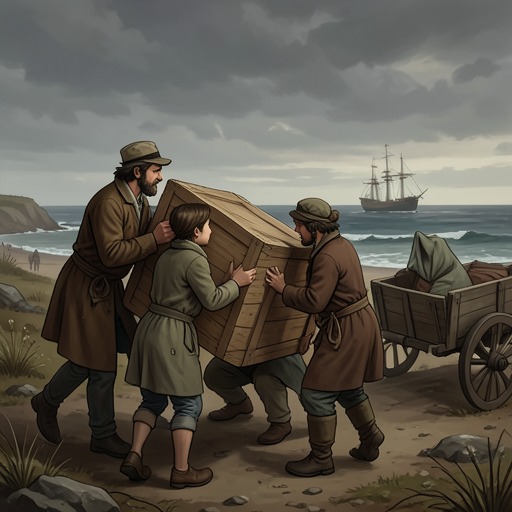
Preparation made the economic limits of departure tangible. The old Nilsa family clothes chest, inherited through generations and once used for treasured possessions and funeral garments, was brought down from the attic and repurposed as a strong packing case. Its new role joined family continuity to rupture: the object that had accompanied household milestones would now travel beyond the parish with the emigrants.
The contents were selected for work and survival. Karl Oskar packed iron and steel tools, including an adz, hatchet, chisel, drawknife, plane, hammer, and auger; he dismantled his muzzle-loader to make it easier to pack. Robert brought fishing tackle, while Nils added a bleeding iron he believed might be useful. Kristina packed wool cards, knitting needles, sheep shears, and a swingle painted with red flowers by Karl Oskar, along with warm clothes and supplies for mending. The loom, spinning wheel, and other familiar implements had to be left behind. These choices show a household carrying the means to build and maintain a life while abandoning much of the equipment through which its old domestic economy had operated.
Food, bedding, and ordinary utensils also had to fit the journey. The family packed bedclothes in two four-bushel sacks and prepared a basket with rye and barley loaves, salted butter, honey, cheese, smoked meat, and salted herring, as well as smaller provisions. Such care was necessary because the passage and the travel after landing were long, and the family did not know whether it would be able to eat the ship’s food. Poverty did not make departure simple or costless: even an attempt to escape it required supplies, transport, and the ability to move a household across an ocean.
When the wagon left Korpamoen, Karl Oskar saw his parents standing together on the porch, left behind as the younger people departed. His final image of them remained fixed in his memory, while the emigrants carried away an old family chest, essential tools, food, and the hope that their labor might produce a different future. The contrast captures the central significance of landlessness and rural poverty in Ljuder: the farm had sustained generations, but its division and obligations could also make staying seem like an inheritance of constraint.